Love this? Save it for later!
Share the inspiration with your friends
I want soup. Not just any soup—the kind that feels like a hug in a bowl, the kind that makes you slow down and actually taste each spoonful. It’s late October, the air has that crisp bite, and I have a butternut squash sitting on my counter that’s been staring at me for three days. I also have sage. Fresh sage, because I impulse-bought it at the farmers’ market last weekend, telling myself I’d find a use for it. This is that use.
Here’s the thing about butternut squash soup—it can be bland. Watery. A sad, orange-colored disappointment that makes you wonder why you bothered. I’ve made those versions. I’ve served those versions. And honestly, I’ve poured them down the drain while muttering under my breath. So when I set out to make this creamy butternut squash sage soup, I had one rule: it needed to taste like something. Like autumn in a bowl, but with actual depth, not just pumpkin spice vibes.
The trick, I discovered, isn’t in the squash itself. It’s in what you do to it before it ever hits the broth. Roasting, not boiling. Letting those edges caramelize until they’re almost burnt. And the sage—oh, the sage gets its own moment too, sizzling in butter until it’s crispy and fragrant. This recipe is the result of several batches, a few failures, and one particularly good afternoon where everything just clicked. It’s the soup I now make every fall, the one my family asks for by name. Let me show you how it comes together.
Why You’ll Love This Recipe
This isn’t your standard squash soup. I’ve tested this version more times than I care to admit, tweaking ratios and roasting times until every spoonful delivers. Here is why it stands out.
- Deep, layered flavor: Roasting the squash and garlic brings out natural sweetness and a hint of smokiness. No bland broth here.
- Silky smooth texture: Blending everything until velvety, with no cream needed. It’s naturally creamy from the squash itself.
- Simple, real ingredients: No heavy cream, no processed shortcuts. Just vegetables, broth, butter, and herbs you can pronounce.
- Quick to pull together: Active prep time is under 20 minutes. The oven does most of the heavy lifting while you do other things.
- Freezer-friendly and make-ahead: This soup tastes even better the next day. Make a double batch and thank yourself later.
- Impressive but unfussy: It looks fancy enough for a dinner party but is easy enough for a Tuesday night when you need comfort food, stat.
What makes this recipe different is the technique. Roasting the squash until it’s deeply caramelized, then sautéing the sage in butter before blending it all together. That little step—browning the sage—changes everything. It’s the difference between a soup that’s good and a soup that makes you close your eyes after the first bite. This is the kind of meal that turns a gray November day into something worth celebrating.
What Ingredients You Will Need
This recipe relies on simple, whole ingredients to build flavor without fuss. Most of these are pantry staples, especially in fall. Here is what you will need and why each one matters.
- Butternut squash (1 large, about 3 pounds): The star of the show. Look for one that feels heavy for its size with a matte, unblemished skin. I prefer organic when possible, but conventional works fine. Peeled, seeded, and cut into 1-inch cubes. Roasting brings out its natural sweetness.
- Yellow onion (1 medium): Adds savory depth. A sweet onion works too, but yellow is my go-to for its balanced flavor.
- Garlic (4 cloves, whole): Roasting whole cloves transforms them into sweet, buttery little gems. Don’t skip this—it’s a key flavor builder.
- Fresh sage leaves (10-12 leaves): This is non-negotiable. Dried sage will not give you the same result. The fresh leaves get crispy in butter and infuse the soup with an earthy, almost piney aroma. I buy a bunch and use the rest for garnish.
- Unsalted butter (3 tablespoons): For sautéing the sage and onion. It adds richness and helps the sage crisp up beautifully. You can use olive oil for a dairy-free version, but butter really is best here.
- Vegetable broth (4 cups): Use a good-quality broth. I like Pacific Foods or Imagine brand for their clean flavor. Low-sodium is ideal so you can control the salt level.
- Salt and black pepper: To taste. I use fine sea salt for cooking and flaky salt for finishing.
- Maple syrup (1 tablespoon, optional): Adds a whisper of sweetness if your squash isn’t super sweet. I only add this if my squash tastes a bit flat.
- Heavy cream or coconut milk (¼ cup, optional): For an extra-luxurious finish. I usually skip it because the soup is already creamy, but it’s a nice touch if you’re serving company.
Substitution notes: If you can’t find butternut squash, buttercup or kabocha squash work well. For a vegan version, use olive oil instead of butter and coconut milk instead of cream. The flavor shifts slightly but remains delicious.
Equipment Needed
You do not need a fancy kitchen to make this soup, but a few tools make the process smoother. Here is what you will need.
- Sharp chef’s knife and vegetable peeler: Butternut squash has tough skin. A good peeler makes quick work of it, and a sharp knife prevents slips when cutting the squash into cubes. I use a Y-shaped peeler—it’s faster than the straight kind.
- Large rimmed baking sheet: For roasting the squash and garlic. A sheet pan with edges prevents juices from spilling into your oven.
- Parchment paper: Makes cleanup a breeze and prevents the squash from sticking. I use unbleached parchment.
- Large heavy-bottomed pot or Dutch oven: For sautéing the aromatics and simmering the soup. A 5- to 6-quart pot is ideal. I love my Lodge enameled Dutch oven for even heat distribution.
- Immersion blender or regular blender: An immersion blender lets you puree the soup right in the pot—less mess, fewer dishes. If using a regular blender, work in batches and vent the lid to avoid pressure buildup.
- Measuring cups and spoons: For accuracy. I keep a set of dry and liquid measures separate.
- Wooden spoon or spatula: For stirring the onions and sage.
If you do not have an immersion blender, a standard blender works perfectly. Just let the soup cool slightly before blending, and hold the lid down with a kitchen towel to be safe. I have made this soup in a small apartment kitchen with minimal tools—it is not a fussy recipe.
Preparation Method

Let me walk you through this step by step. The process is straightforward, and each step builds on the last to create a soup with real depth.
- Preheat your oven to 400°F (200°C). Line a large baking sheet with parchment paper. This high heat is key for caramelizing the squash.
- Prep the squash and garlic. Peel the butternut squash with a vegetable peeler, then cut it in half lengthwise. Scoop out the seeds and stringy bits with a spoon. Cut the squash into 1-inch cubes—try to keep them uniform so they roast evenly. Place the cubes on the prepared baking sheet. Add the 4 whole garlic cloves (skin on) to the sheet. Drizzle everything with 2 tablespoons of olive oil and a generous pinch of salt. Toss to coat, then spread in a single layer. Do not overcrowd—if the pieces are touching too much, they will steam instead of roast.
- Roast for 30-35 minutes. Toss the squash halfway through. You want the edges to be deeply golden and slightly caramelized—some spots may look almost burnt. That is good. The garlic cloves should be soft and fragrant. Remove from the oven and let cool slightly. Once cool enough to handle, squeeze the garlic cloves out of their skins—they will pop right out.
- While the squash roasts, prep the aromatics. Dice the onion into small pieces. Pick the sage leaves off the stems and give them a rough chop, leaving a few whole for garnish.
- Start the soup base. Place your large pot over medium heat. Add the butter and let it melt until it starts to foam. Add the chopped sage leaves and cook for 1-2 minutes, stirring constantly, until the sage is fragrant and starting to crisp. Do not walk away—sage burns fast. Use a slotted spoon to transfer the crispy sage to a small plate and set aside for garnish.
- Sauté the onion. In the same pot with the remaining butter, add the diced onion. Cook over medium heat for 5-7 minutes, stirring occasionally, until the onion is soft and translucent. It should not brown—just soften. If it starts to stick, add a splash of broth.
- Add the roasted squash and garlic. Tip the roasted squash cubes and the squeezed garlic cloves into the pot with the onions. Stir to combine. Let everything cook together for 1 minute, allowing the flavors to meld.
- Pour in the broth. Add the 4 cups of vegetable broth. Stir well, scraping up any browned bits from the bottom of the pot. Bring the soup to a gentle simmer over medium-high heat, then reduce the heat to low. Let it simmer for 10 minutes. This gives the flavors time to marry.
- Blend until smooth. Remove the pot from the heat. If using an immersion blender, submerge it and blend until the soup is completely smooth. If using a regular blender, let the soup cool for 5 minutes, then carefully transfer it in batches (fill the blender no more than halfway) and blend until velvety. Return the blended soup to the pot.
- Season and finish. Stir in the maple syrup if using, plus salt and pepper to taste. Start with ½ teaspoon of salt and adjust from there. If you want an extra-creamy finish, stir in the heavy cream or coconut milk. Taste again and adjust seasoning. The soup should be rich, savory, with a hint of sweetness and a clear sage note.
- Serve immediately. Ladle the soup into bowls. Top with the reserved crispy sage leaves and a crack of black pepper. A drizzle of olive oil or a dollop of crème fraîche is lovely but optional.
Sensory cues: At step 3, the squash should smell sweet and nutty when done. The edges should look almost candied. At step 5, the sage will release a strong, earthy aroma—that is your cue to stop cooking it. At step 9, the soup should look thick and glossy, not watery. If it seems too thick, add another ¼ cup of broth.
Cooking Tips & Techniques
I have made this soup at least a dozen times, and I have learned a few things the hard way. Here are my best tips for getting it right every time.
- Do not rush the roasting. I once tried to speed things up by boiling the squash instead of roasting it. The result was a watery, bland soup that tasted sad. Roasting concentrates the squash’s natural sugars and adds a depth you cannot get any other way. Give it the full 35 minutes, and do not be afraid of dark edges.
- Use fresh sage, not dried. Dried sage has a musty, one-dimensional flavor. Fresh sage is bright and aromatic. If you only have dried, use half the amount and add it with the broth rather than frying it in butter. But honestly, fresh is worth the trip to the store.
- Season in layers. Add salt at the roasting stage, again when sautéing the onion, and finally at the blending stage. This builds flavor gradually rather than dumping it all in at the end. I learned this from a chef friend who said, “Salt is not a finish—it is a process.”
- Watch the sage closely. The first time I made this, I walked away from the pan for 30 seconds and returned to blackened, bitter sage. It goes from perfectly crisp to burnt in seconds. Keep it moving in the pan and pull it the moment it darkens slightly.
- Blend hot, but carefully. Hot soup blends more smoothly than cold soup. If using a regular blender, let the steam escape by removing the center cap and covering the hole with a folded kitchen towel. Do not seal the lid tight—pressure buildup can cause the lid to blow off.
- Make it ahead. This soup actually improves after a day in the fridge. The flavors meld and deepen. I often make it on a Sunday and enjoy it for lunches throughout the week. Just reheat gently on the stove, adding a splash of broth if it has thickened.
Variations & Adaptations
One of the best things about this soup is how easily it adapts. Here are a few ways to change it up depending on your mood or what you have on hand.
- Vegan version: Use olive oil instead of butter for sautéing the sage and onion. Skip the cream at the end. The soup remains incredibly creamy thanks to the blended squash. I have made this for vegan friends and no one missed the dairy.
- Spicy kick: Add a pinch of red pepper flakes along with the sage, or stir in ½ teaspoon of smoked paprika with the onions. The heat plays beautifully against the sweet squash. I tried this on a whim one night and now it is my husband’s favorite version.
- Apple-squash fusion: Peel and chop one apple (Honeycrisp or Fuji work well) and add it to the baking sheet with the squash. Roast together. The apple adds a subtle fruity sweetness that complements the sage. This is a great way to use up apples that are past their prime.
- Coconut twist: Swap the butter for coconut oil and use full-fat coconut milk instead of cream. The coconut flavor pairs surprisingly well with sage and squash. I serve this version with toasted coconut flakes on top for texture.
- Roasted carrot addition: Add 2-3 peeled and chopped carrots to the baking sheet with the squash. Carrots reinforce the sweetness and add a beautiful orange hue. This is my go-to when I want an extra nutrient boost.
- Herb swap: If you cannot find sage, try fresh thyme or rosemary. Use about 4 sprigs of thyme or 1 tablespoon of chopped rosemary. The flavor profile changes but remains deliciously autumnal.
I have tried all of these variations at one point or another. The apple version surprised me the most—I did not expect the fruit to meld so seamlessly with the savory elements. Feel free to experiment and make this soup your own.
Serving & Storage Suggestions
This soup is versatile enough for a quick lunch or a dressed-up dinner. Here is how to serve and store it for best results.
Serving: Ladle the soup into warm bowls for the best experience. I like to serve it with a crusty piece of bread for dipping—sourdough or a good baguette works beautifully. For a heartier meal, pair it with a roasted tomato basil soup for a soup flight, or serve alongside a crispy hatch chili cheddar cornbread skillet for a satisfying fall dinner. A simple green salad with a tangy vinaigrette cuts through the richness nicely. For a festive touch, top each bowl with a swirl of cream, the crispy sage, and a sprinkle of pumpkin seeds or pomegranate arils.
Storage: Let the soup cool completely before transferring it to an airtight container. It will keep in the refrigerator for up to 5 days. The flavors actually deepen over time, so do not be surprised if it tastes even better on day three. To freeze, pour the cooled soup into freezer-safe bags or containers, leaving an inch of headroom for expansion. It freezes well for up to 3 months. Thaw overnight in the refrigerator before reheating.
Reheating: Reheat the soup gently on the stovetop over medium-low heat, stirring occasionally. Add a splash of broth or water if it has thickened too much. You can also microwave individual portions in 30-second bursts, stirring between each. Avoid boiling the soup once it is blended—it can cause the texture to become grainy.
Nutritional Information & Benefits
This soup is as good for you as it is delicious. Here is a rough breakdown per serving (based on 6 servings, without optional cream).
- Calories: Approximately 180 per serving
- Fat: 8g (mostly from olive oil and butter)
- Carbohydrates: 28g
- Fiber: 6g
- Protein: 3g
- Sugar: 8g (natural, from squash)
- Sodium: 450mg (varies based on broth and added salt)
Health highlights: Butternut squash is packed with vitamin A (over 400% of your daily needs per cup), vitamin C, and potassium. It is also rich in antioxidants like beta-carotene, which supports eye health and immune function. The sage in this recipe is not just for flavor—it has anti-inflammatory properties and is known to aid digestion. By skipping heavy cream, this soup keeps the fat content moderate while still delivering a luxurious texture. It is naturally gluten-free and can easily be made vegan. If you are watching your sodium, use low-sodium broth and adjust the salt at the end.
I love that this soup feels indulgent but is actually a nutrient powerhouse. It is the kind of meal that fills you up without weighing you down—perfect for those transitional fall days when you want comfort without the guilt.
Conclusion
This creamy butternut squash sage soup has become a staple in my kitchen for good reason. It is simple enough for a weeknight, impressive enough for company, and deeply satisfying in that way only a well-made soup can be. The combination of caramelized squash, fragrant sage, and silky texture hits every note I want in a fall dish.
I encourage you to make this recipe your own. Adjust the herbs, play with the toppings, double the batch for the freezer. The beauty of soup is that it is forgiving—it wants to be adapted. Whether you serve it as a starter for a holiday meal or as the main event with a side of crusty bread, I think you will find yourself coming back to this recipe year after year.
If you give this soup a try, I would love to hear about it. Leave a comment below and let me know how it turned out, or share your own twist on the recipe. Did you add apple? Try it with coconut milk? Tell me about it. And if you are looking for more cozy fall recipes, check out this moist pumpkin cream cheese swirl muffins recipe for a sweet companion to your soup. Happy cooking, friends—may your kitchen smell like sage and butter and everything good.
Frequently Asked Questions
Can I make this soup without an immersion blender?
Absolutely. A standard countertop blender works perfectly. Just let the soup cool for a few minutes before blending, work in batches, and hold the lid down with a towel to prevent steam from popping it open. An immersion blender is convenient but not essential.
Can I use frozen butternut squash instead of fresh?
You can, but the texture will be different. Frozen squash releases more water during cooking, which can make the soup less concentrated in flavor. If using frozen, thaw it first, pat it dry, and roast it on a higher heat (425°F) to encourage caramelization. The soup will still be good, just not quite as rich.
How do I make this soup thicker?
If your soup turns out thinner than you like, let it simmer uncovered for an additional 10-15 minutes to reduce and concentrate. Alternatively, blend in a handful of roasted cashews or a peeled, cooked potato for added body without changing the flavor too much.
Can I use dried sage instead of fresh?
You can, but the flavor will be different. Dried sage is more pungent and less aromatic than fresh. If using dried, use about 1 teaspoon and add it with the broth rather than frying it in butter. I strongly recommend fresh sage for this recipe—it makes a noticeable difference.
Is this soup freezer-friendly?
Yes, it freezes beautifully. Let the soup cool completely, then transfer it to freezer-safe containers or bags. Leave some space for expansion. It will keep for up to 3 months. Thaw overnight in the fridge and reheat gently on the stove. The texture remains smooth after thawing.
Pin This Recipe!
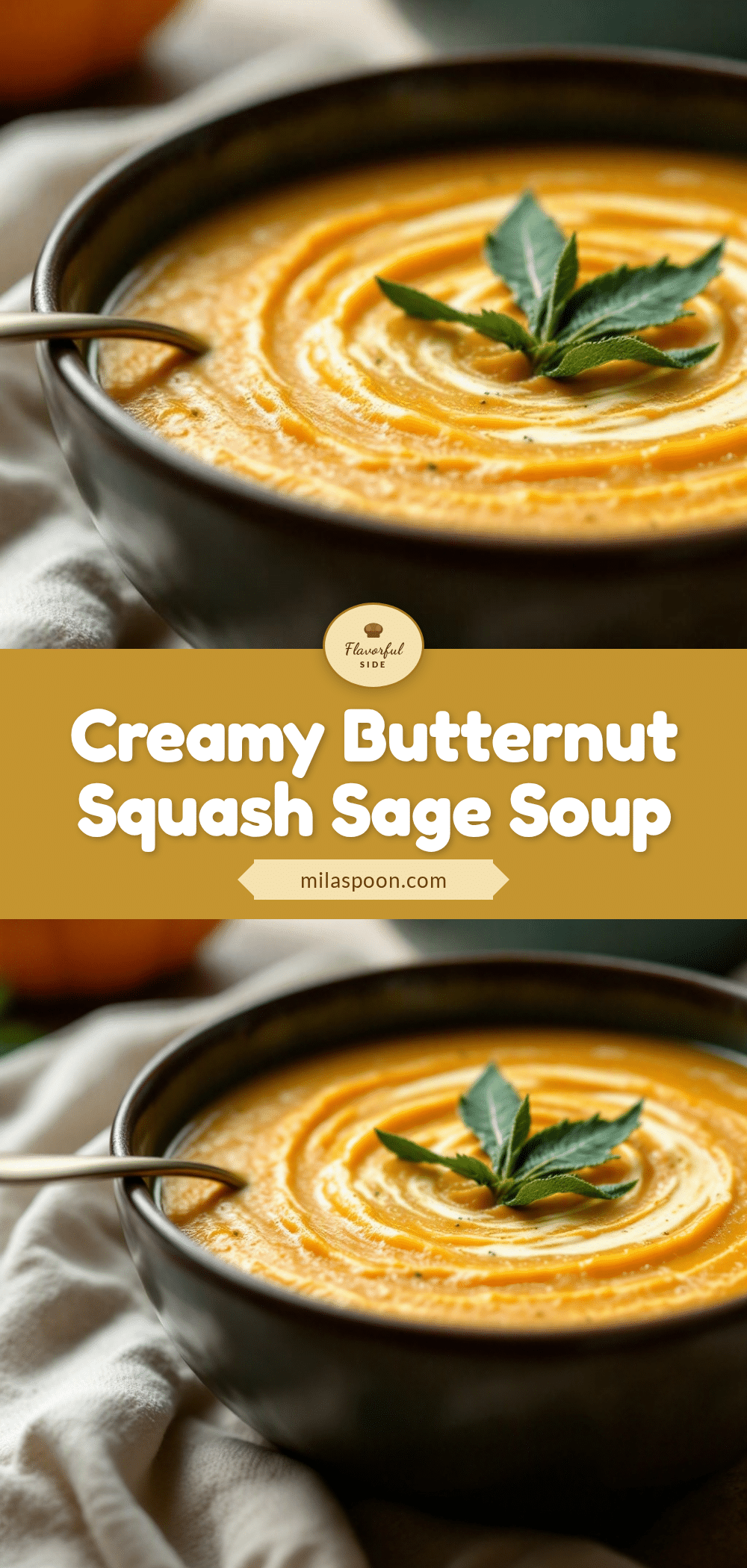
Easy Creamy Butternut Squash Sage Soup Recipe

This creamy butternut squash sage soup is deeply flavorful, silky smooth, and made with simple, real ingredients. Roasting the squash and garlic brings out natural sweetness, while crispy sage adds an earthy aroma.
- Prep Time: 20 minutes
- Cook Time: 45 minutes
- Total Time: 1 hour 5 minutes
- Yield: 6 servings 1x
- Category: Soup
- Cuisine: American
Ingredients
- 1 large butternut squash (about 3 pounds), peeled, seeded, and cut into 1-inch cubes
- 1 medium yellow onion, diced
- 4 cloves garlic, whole
- 10–12 fresh sage leaves, roughly chopped (plus a few whole for garnish)
- 3 tablespoons unsalted butter
- 4 cups vegetable broth (low-sodium preferred)
- Salt and black pepper to taste
- 1 tablespoon maple syrup (optional)
- 1/4 cup heavy cream or coconut milk (optional)
Instructions
- Preheat your oven to 400°F (200°C). Line a large baking sheet with parchment paper.
- Peel the butternut squash, cut it in half lengthwise, and scoop out the seeds. Cut into 1-inch cubes. Place on the baking sheet with the whole garlic cloves. Drizzle with 2 tablespoons olive oil and a generous pinch of salt. Toss to coat and spread in a single layer.
- Roast for 30-35 minutes, tossing halfway through, until the squash is deeply golden and caramelized. The garlic should be soft. Let cool slightly, then squeeze the garlic cloves out of their skins.
- While the squash roasts, dice the onion and chop the sage leaves.
- In a large pot over medium heat, melt the butter until it foams. Add the chopped sage and cook for 1-2 minutes, stirring constantly, until fragrant and starting to crisp. Use a slotted spoon to transfer the crispy sage to a plate for garnish.
- In the same pot, add the diced onion and cook over medium heat for 5-7 minutes, until soft and translucent.
- Add the roasted squash and garlic to the pot. Stir and cook for 1 minute.
- Pour in the vegetable broth, scraping up any browned bits. Bring to a gentle simmer, then reduce heat to low and simmer for 10 minutes.
- Remove from heat. Using an immersion blender, blend until smooth. If using a regular blender, let cool for 5 minutes, then blend in batches, holding the lid with a towel.
- Stir in maple syrup (if using), salt, and pepper to taste. Add heavy cream or coconut milk if desired. Adjust seasoning.
- Serve immediately, topped with reserved crispy sage leaves and a crack of black pepper.
Notes
Do not rush the roasting—caramelization is key for flavor. Use fresh sage, not dried. Season in layers for best results. Watch the sage closely when frying to avoid burning. The soup improves after a day in the fridge. For a vegan version, use olive oil instead of butter and coconut milk instead of cream.
Nutrition
- Serving Size: 1 bowl (about 1.5 cu
- Calories: 180
- Sugar: 8
- Sodium: 450
- Fat: 8
- Saturated Fat: 3
- Carbohydrates: 28
- Fiber: 6
- Protein: 3
Keywords: butternut squash soup, creamy soup, sage soup, fall soup, vegetarian soup, gluten-free soup, easy soup recipe